1387
Villiage and Castle Clevenow were mentioned in a document for the first time. At this time the first generation of stone-built castles was errected in northern Germany. The stone-built castles began replacing older-type wood structures surrounded by walls of earth and motes, which were predominant up to that time, and of which only fragments are left over today. This is why Klevenow is one of the oldest builings in northern Germany today.
1484
„de Olde Hans von Wakenitz“ (“the old Hans of Wakenitz”), head of the castle Grimmen und bailift (head) of the Pomeranian border land Grimmen and Tribsees, was invested with the Castle Klevenow (a castle with a water mote around it for fortification) by the Pomeranian Duke.
1503
The investment document was confirmed several times in Wolgast, also by the famous Duke Bogislaw X. of Pomerania.
Stettiner document “Donnerstag in den Pfingsten”
(transl. “Thursday in the Whitsun”):
“Old Hans tho Clevenow, Thomas, Junge Hans und Gerth, vedderen und brödere de Wakenitze genomet mit ihrem Erbe und Lehen in den gütern Tressow, Kisow, Nigendorpe, Cernewanze, Wustenie, Czemmin, Golzlove, Parsowe und Clevenow”
(transl. “Old Hans of Clevenow, Thomas, young Hans and Gerth, cousins and brothers of the Wakenitzes have taken the investments and inheritences of the manors and land around Tressow, Kisow, Nigendorpe, Cernewanze, Wustenie, Czemmin, Golzlove, Parsowe and Clevenow”)
1618-1648
During the thirty years war hard-fought battles took place over Castle Clevenow.
1627
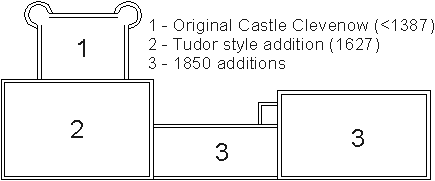
Carl of Wakenitz began renovations already during the thirty years war, after fighting moved on to other parts of Germany. An iron weather mast in the form of a rooster with the inscription “C. von Wakenitz 1627” was on one of the towers until the 20th century.
1636
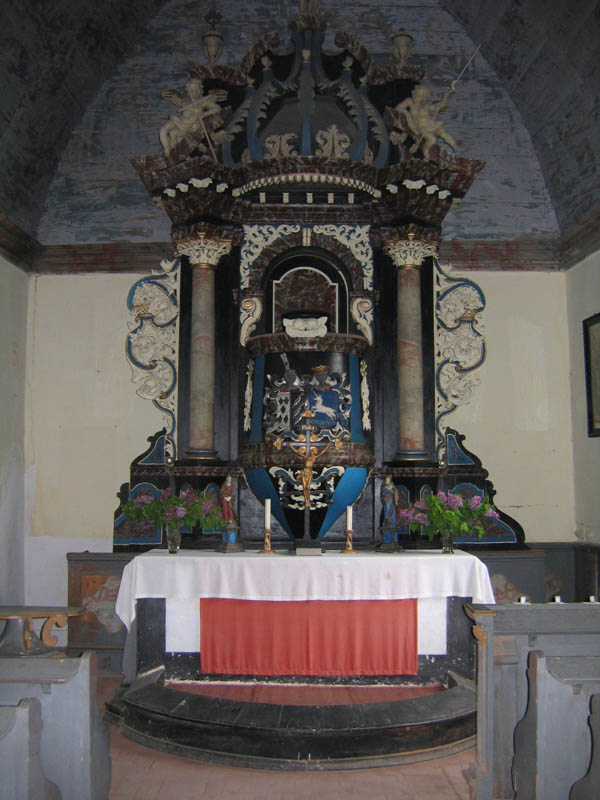
The chapel is a rectangluar, tudor style building with a mansard roof. Inside is a wooden arched ceiling, painted with angels and winding patterns. The portal frame is enhanced with wooden pilasters and the gable head with coats of arms.
1648
Western Pomerania officially belongs to Sweden.
1695
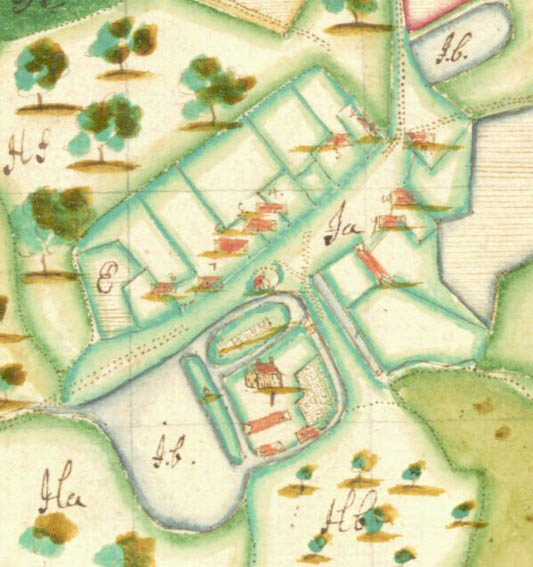
One of the Swedish registery maps coveing Clevenow was drawn up in 1695. Here is a part of this map, which shows the castle and the immediate vicinity. The mote, barock gardens and a drawing of the castle with it’s two towers and the chapel are shown.
End of the 18th century
At the end of the 18th century Clevenow was turned into an entailed estate by Carls great grandson Karl Franz Ludwig of Wakenitz. It stated that if the male side of the family should die out that his daughter Emilie should inherit Clevenow with it’s grounds.
1815
Western Pomerania is assigned to Denmark. In the same year Prussia baught Western Pomerania and the Duchy of Lauenburg from Denmark for 3.5 Million Talers.
1816
One of the Wakenitzes heirs marries the swedish lieutenant-colonel Carl Friedrich of the Lancken (from Boldevitz on Ruegen). Between this time and 1945 (the end of the second world war) the owners of Klevenow carried the name Lancken-Wakenitz.
1835
The Prussians draw a map of the area around Clevenow. The castle surrounded by a reinforced mote and the chapel can be seen on the map.

1848
A part of the working quarters lying within the old moted castle burnt down in 1848. Fritz baron from the Lancken-Wackenitz took this oppurtunity to modernise Klevenow. He filled in the moat, built living quarters for the workers, built a school, a forestery, new stables, and agricultural buildings. He landscaped the grounds to an english garden, which was modern at the time. This park extended over 15 hectares and included the river Trebel, artificial lakes with islands and age old oak trees. These are all still there today.
He renovated the rest of the mideval castle including the facade between the two old towers in the neo-gothic style. Pointed tent roofs were place on the two towers, and the windows were replaced with neo-gothic style windows. The narrow windows in the towers were replaced with windows pointed at the top (also neo-gothic style) and the gable was spruced up with three mini towers. Towards the east a new building was built on to the castle.
1858
Ferdinand Jühlke wrote:
„Clevenow ist ein höchst anmuthiger Sitz, der mit seinen Anpflanzungen einen ausgezeichneten Bestand der seltensten und schönsten Holzarten darbietet… Überall tritt uns hier die Natur in verschönerter Weise entgegen und führt uns in gestaltreicher Mannigfaltigkeit Gruppierungen vor Augen, die der bildenden Gartenkunst in Farbton und Form der Belaubung als nachahmenswerthes Beispiel empfohlen zu werden verdient…“
(transl. “Clevenow is a highly graceful residence, which has an acceptional array of the most rare and beautiful trees… Nature in it’s beautified state in dazzling diversity for the eye is an example of visual garden art which is worthy being copied.”)
1862

Klevenow after the renovation.
1887
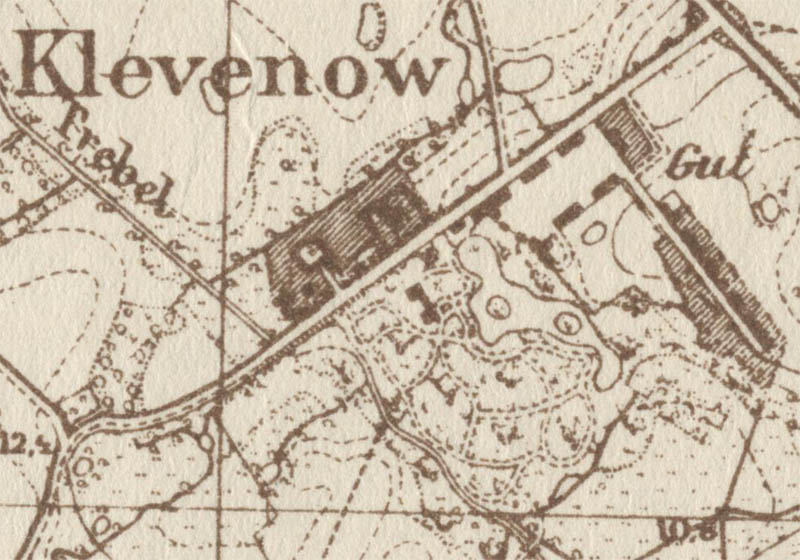
The Prussians have another map of the area around Klevenow drawn up. The details of the castle and the english garden can be seen.
1920’s
Malte Baron from the Lancken-Wakenitz started modernisations and renovations after the end of the first world war. Water and electricity were laid, while preserving the look of the old castle.
1945
Castle Klevenow and it’s estate of around 500 hectares of agriculturally used land were taken over by the Soviet occupying power.
1945 to 2003
Castle Klevenow was used by the community as living quarters, town hall, school, cooperative store, doctors office, youth club, and so forth. During the communist times under East German rule the castle was historically protected (one of only a few manors), and various maintenece measures were taken. The agricultural farm was separated from the castle and carried on as an agricultural coop.
2003
Robert and Steffen Knoop buy Castle Klevenow and begin with the renovations.
